Cross-Discipline Accumulators: Weaving Racing Track Data with Tennis Court Metrics
Ines Baumann · Jun 21, 2026

Cross-Discipline Accumulators: Weaving Racing Track Data with Tennis Court Metrics
Analysts in the betting sector have long examined how surface conditions influence outcomes across different sports, and recent approaches now combine equine track variants with tennis court analytics to inform multi-leg wagers that span racing and racket events. Track variants encompass factors such as turf firmness ratings, moisture levels after rainfall, and distance adjustments that alter pace expectations for runners, while court metrics track player performance splits on clay, grass, or hard courts along with break-point conversion rates and rally lengths under varying conditions. When these datasets merge into layered betting structures, they create opportunities for accumulators that link selections from afternoon racing cards to evening tennis matches.
Understanding Track Variants in Equine Events
Horse racing surfaces shift with weather patterns and maintenance schedules, so observers record going descriptions that range from firm to heavy while noting rail positions and wind directions that affect times. Data from major circuits shows that horses with prior success on similar ground conditions post higher strike rates, and algorithms now incorporate these variables to adjust implied probabilities before odds compilation. In June 2026 several European festivals reported unusually dry spells that hardened tracks earlier than seasonal norms, prompting bettors to cross-reference historical pace figures with current moisture readings when constructing legs of larger wagers.
Court Metrics That Shape Tennis Outcomes
Tennis surfaces dictate movement patterns and ball behavior, so performance databases break down win percentages for individual players across surface categories while factoring in fatigue from previous rounds and altitude effects at certain venues. Researchers at institutions such as the University of Queensland have published papers detailing how serve speeds drop on slower clay courts and how return points won rise correspondingly, providing quantitative edges that operators integrate into pricing models. Those who study match logs often discover that players with strong records on specific court types maintain consistency even when schedules compress during grand-slam weeks.
Combining Datasets for Multi-Leg Structures
Operators and syndicates now feed both track and court variables into the same predictive frameworks so that a wager might include a horse expected to handle a drying surface paired with a tennis player favored on the evening's court type. This interweaving reduces variance because independent variables from separate disciplines rarely correlate directly, yet the combined probability calculation still accounts for each leg's conditional edge. One documented approach involves weighting recent track bias reports against a tennis competitor's surface-specific ace percentage, then scaling stake sizes across the accumulator accordingly.
What's interesting is how live updates during race days and match sessions allow dynamic adjustments, since fresh track reports or court wear observations can shift implied values mid-card. Bettors who monitor these streams frequently adjust remaining legs rather than locking selections hours in advance, and software platforms now display real-time metric overlays that highlight when a track variant moves outside historical ranges or when a player's court metric deviates from seasonal averages.
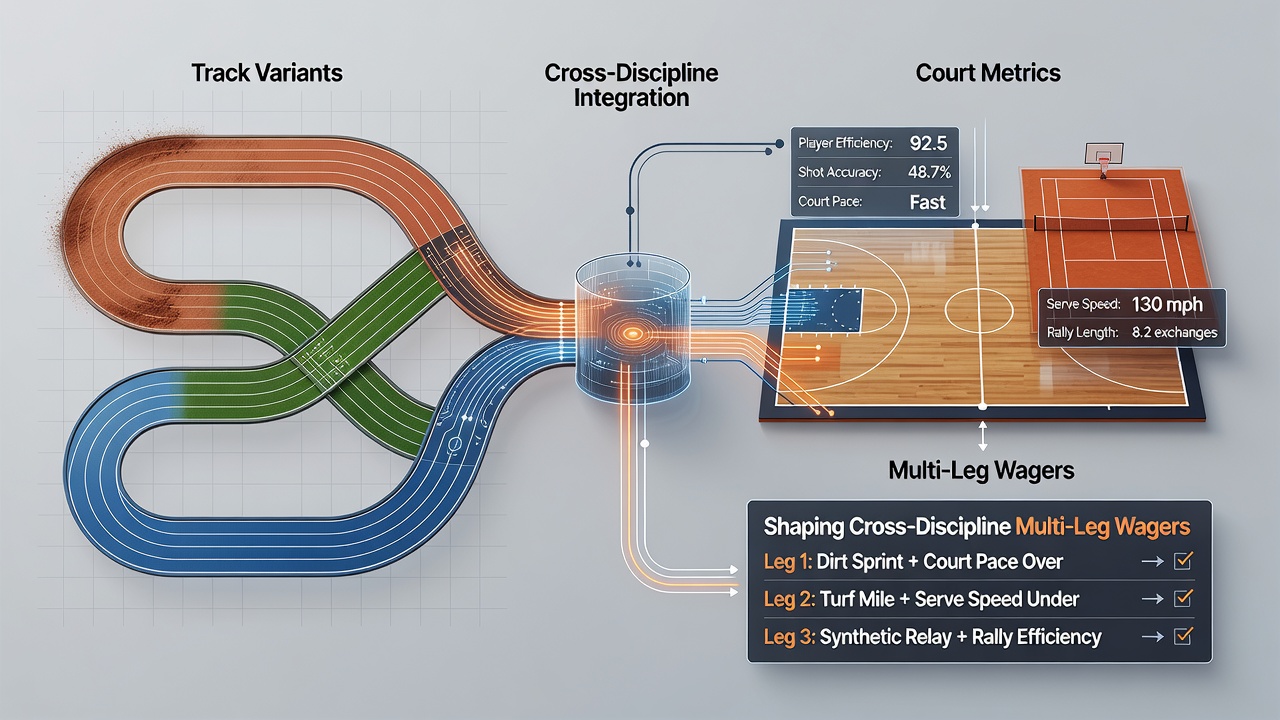
Practical Implementation Across Regions
North American and Australian markets have adopted similar cross-discipline models, with reports from the American Gaming Association noting increased interest in multi-sport products that blend thoroughbred data with tennis surface statistics. Canadian provincial regulators have likewise tracked rising volumes in such wagers, attributing part of the growth to improved data feeds that arrive from both racing authorities and tennis federations. Because each sport operates under distinct governing bodies, the datasets remain largely independent, which supports the statistical assumption of limited covariance when calculating joint probabilities for accumulator payouts.
Take one operator who integrated automated alerts for track moisture changes alongside tennis court speed indices; the system flagged instances where a morning rain shower altered expected pace figures, prompting revised odds on related tennis selections scheduled later that day. Observers note that such synchronization requires robust data pipelines yet delivers measurable improvements in edge identification when historical samples span multiple seasons. Studies from research groups in Europe and Oceania confirm that surface-specific modeling lifts accuracy rates modestly but consistently across combined selections.
Current Landscape in Mid-2026
By June 2026 several platforms had rolled out dedicated interfaces that display track variant sliders next to court metric heat maps, allowing users to visualize how adjustments in one domain ripple through the overall accumulator price. Industry reports indicate that participation in these layered products has risen steadily, driven by the availability of granular statistics rather than promotional incentives alone. Regulatory filings from non-UK jurisdictions show that operators must maintain audit trails for the data sources feeding these models, ensuring transparency when surface conditions update in real time.
Yet the core challenge remains accurate weighting of each variable's contribution to final probabilities, since over-reliance on a single track report or isolated court statistic can skew the entire structure. Those who maintain diversified data inputs across multiple racing circuits and tennis tours tend to achieve more stable long-term results according to aggregated performance reviews.
Conclusion
The practice of interweaving track variants with court metrics continues to evolve as data collection improves and modeling techniques refine, offering structured ways to approach cross-discipline multi-leg wagers without assuming direct causation between the sports. Continued monitoring of surface conditions in both racing and tennis, paired with transparent probability frameworks, supports the ongoing development of these combined betting formats across global markets.