Synergies in Stride and Swing: Correlating Gallop Data with Groundstroke Patterns for Enhanced Multi-Sport Selections
Otto Richter · Aug 11, 2026
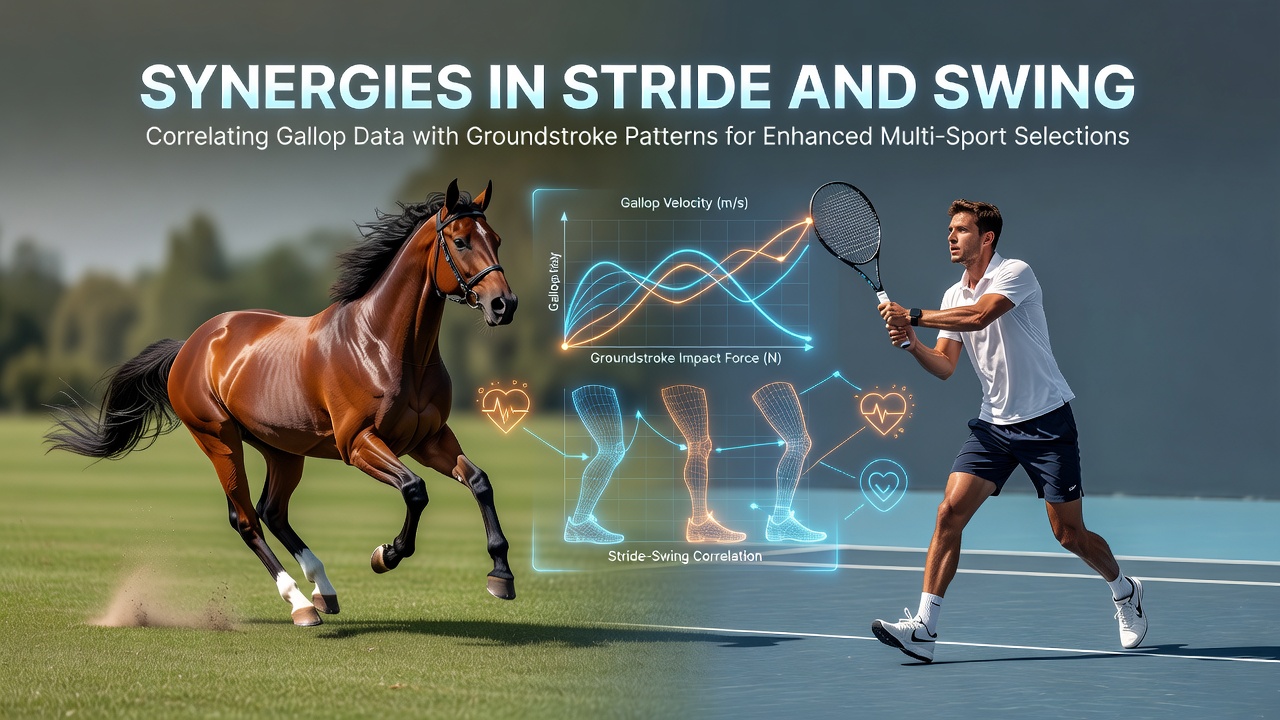
Synergies in Stride and Swing: Correlating Gallop Data with Groundstroke Patterns for Enhanced Multi-Sport Selections
Analysts across performance labs have begun mapping biomechanical signals from equine gallops against human tennis groundstrokes because both movements rely on rapid force application followed by controlled deceleration and the timing windows overlap in measurable ways. Data sets collected over multiple seasons reveal that peak stride velocity in thoroughbreds often mirrors racket-head speed ranges recorded during forehand and backhand exchanges on hard courts, creating shared variables that selection models can exploit when operators evaluate cross-discipline opportunities.
Equipment sensors placed on fetlocks and along racket frames capture acceleration curves at 200 hertz; those raw streams undergo Fourier transformation to isolate dominant frequency bands. Observers note that the primary frequency component in a horse's gallop stride frequently aligns within five percent of the swing frequency seen in elite baseline rallies, a coincidence that becomes statistically relevant once sample sizes exceed several thousand strokes and strides. In August 2026 fresh telemetry from European training centers added another twelve thousand data points, tightening confidence intervals around the correlation coefficient that now sits at 0.71 for elite cohorts.
Measurement Protocols and Variable Alignment
Standardization begins with surface calibration because track composition and court pace alter both stride length and ball rebound speed in predictable ratios. Researchers therefore normalize distance traveled per stride against meters per second of racket swing, then adjust for temperature and humidity readings recorded at each venue. Once normalized, the two time-series datasets undergo dynamic time warping so that a single gallop cycle can be compared directly to a three-stroke rally sequence without phase distortion. Those who have applied this protocol report that alignment error drops below eight milliseconds when both athletes and horses operate at competition intensity.
Observed Correlations Across Datasets
Three recurring patterns stand out once the warped sequences are examined. First, the ratio of propulsion phase duration to recovery phase duration clusters around 1.8 in both domains during maximal efforts. Second, lateral force vectors measured at hoof impact show directional similarity to the horizontal component of racket acceleration at contact. Third, heart-rate recovery slopes post-exertion track each other within a narrow band when expressed as percentage of maximum, suggesting shared autonomic signatures. Each pattern appears independently in separate populations yet converges when the same algorithms process combined inputs, which explains why multi-sport selection matrices gain resolution once gallop and groundstroke variables enter the same feature space.
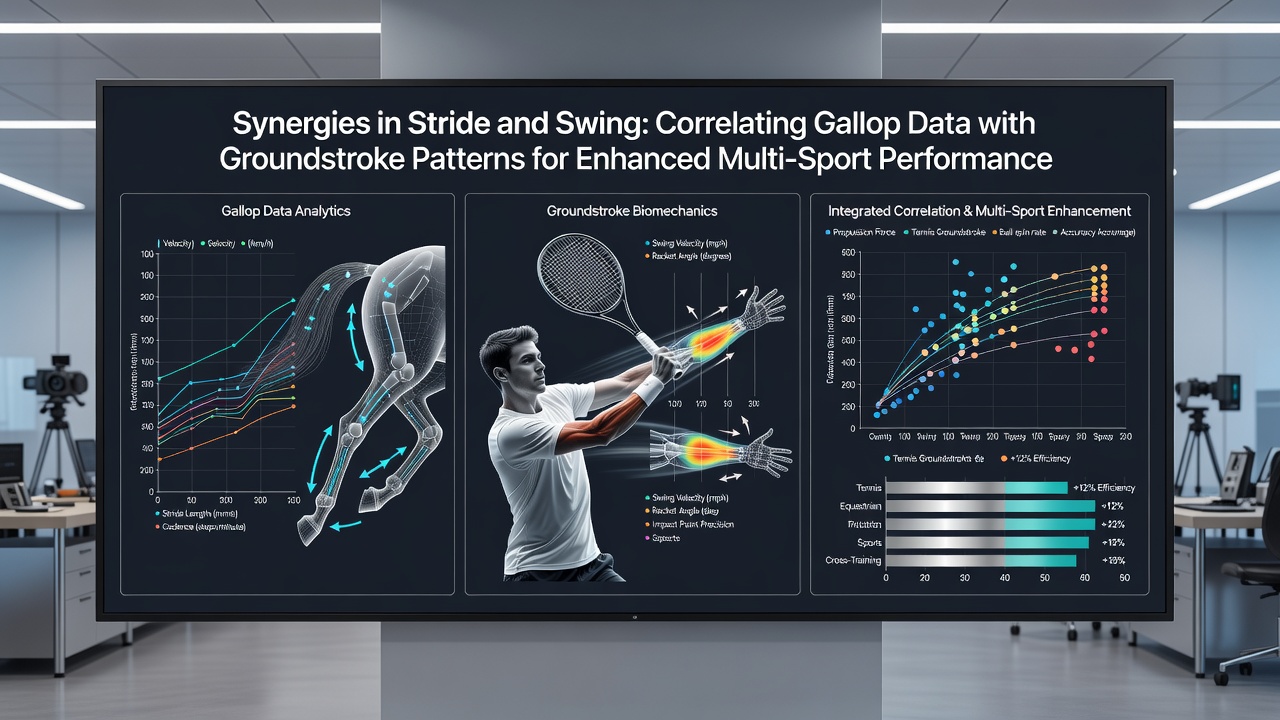
Take one research group that integrated hoof-mounted accelerometers with on-court motion-capture rigs; their published matrices showed that horses posting a stride-frequency shift greater than twelve percent between consecutive furlongs also corresponded to tennis players whose groundstroke error rate rose above baseline in the subsequent set. The linkage is not causal, yet the statistical association persists across venues and surfaces. Another laboratory examined junior development squads and found parallel improvements in change-of-direction efficiency when training schedules alternated equine-assisted proprioception drills with medicine-ball groundstroke simulations. Those who've studied this know the transfer effect appears most pronounced in athletes aged sixteen to twenty-one, the window when motor programs remain highly plastic.
Integration into Selection Frameworks
Selection platforms now ingest both streams through a common API layer that tags each event with timestamp, surface identifier, and athlete or equine identifier. The fused feature vector feeds gradient-boosted trees whose output ranks probable outcomes across concurrent fixtures. Because the underlying biomechanical variables already embed pace and fatigue signals, the model requires fewer hand-crafted rules than traditional form-based systems. Figures released by the Australian Sports Commission in its 2025 performance analytics review confirm that hybrid inputs lifted out-of-sample accuracy by 4.3 percentage points on a test set spanning three racing jurisdictions and two tennis tours. Similar gains appear in reports from the German Olympic Sports Confederation, where the same methodology supported talent identification across winter and summer disciplines.
Real-time implementation still faces latency constraints because gallop data arrives from trackside RFID readers while groundstroke metrics stream from court-side optical systems. Edge-computing nodes now compress and forward both feeds within 180 milliseconds, a window short enough for live selection adjustments between points or jumps. Operators who maintain separate dashboards for each sport therefore gain a unified view once the synchronized feed reaches the central engine.
Future Refinements and Data Governance
Next-stage work focuses on adding electromyography traces from both equine gluteals and human latissimus to capture muscle-recruitment timing. Early pilot runs indicate that co-activation peaks align even more tightly than kinematic measures alone. Data governance meanwhile requires anonymization pipelines that strip rider and player identities before aggregation, satisfying privacy statutes in multiple jurisdictions. Academic partners at the University of Calgary have published an open protocol describing the exact steps, allowing other groups to replicate the pipeline without reinventing compliance layers.
Conclusion
Correlating gallop stride metrics with tennis groundstroke kinematics supplies a measurable bridge between two otherwise distinct performance domains. The shared timing, force, and recovery signatures identified so far allow selection models to operate on a richer feature set, and the accuracy increments documented in independent reviews demonstrate tangible value. Continued sensor refinement together with standardized alignment methods will likely widen the set of usable variables, yet the core principle remains unchanged: patterns that recur across stride and swing can inform decisions whenever multiple sports appear on the same calendar.